Reading an Early Account Without Guessing the Ending
Reading an early account is easier when you track what changed, what remains unresolved, and which source supplied each new detail.
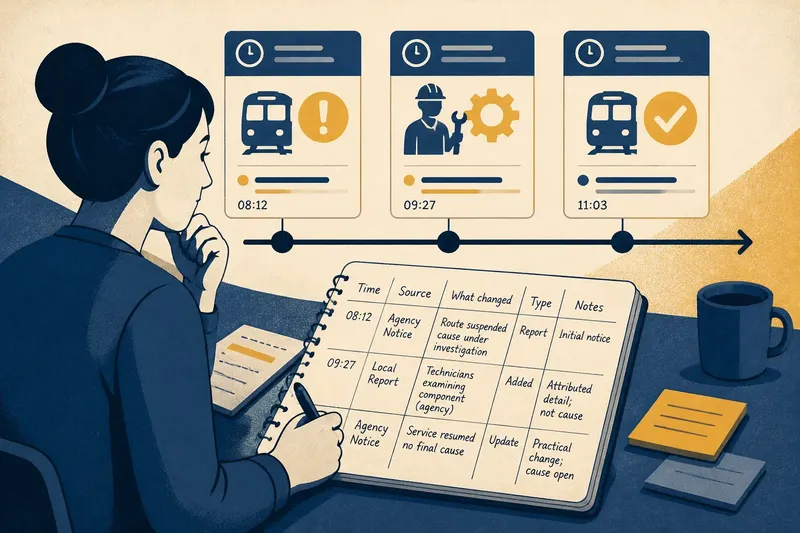
In an early account of a transit disruption, the route may be confirmed as closed while the cause remains under review. Reading an early account well means tracking how information moves between reports—not trying to decide in advance which explanation will prevail.
Track changes in the account, not just its latest wording
A developing story often changes in small, uneven ways. One update may correct a location, another may add an official statement, and a third may repeat the same unresolved explanation. A newer timestamp tells you when a page changed; it does not tell you what changed or why.
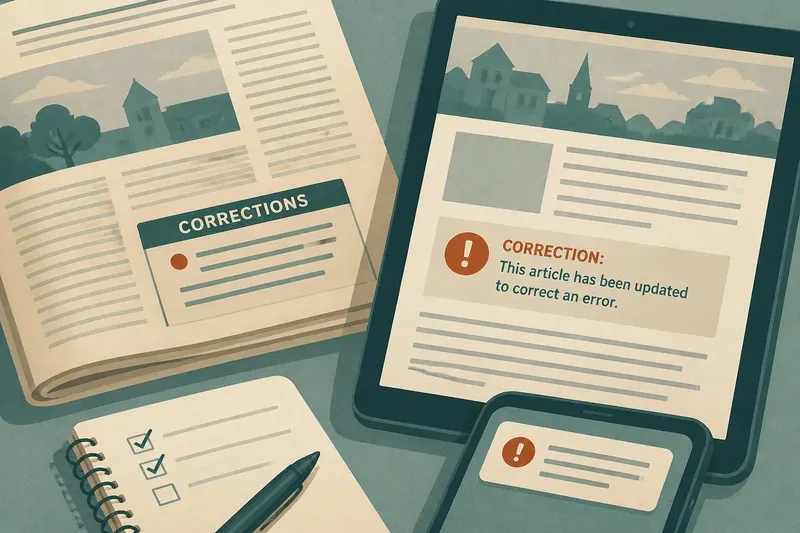
When an update matters, compare the relevant passage with the earlier version. Look for an explicit correction, newly attributed information, or language that has simply been carried forward. This keeps a repeated claim from seeming newly substantiated.
Keep a compact record of each update
For a story that affects a decision or is circulating in conflicting versions, a short note can preserve its history. Record the outlet or source, the time shown on the account, the wording that changed, and whether the update corrects, adds, or repeats information. Keep the original wording when it matters; a paraphrase can accidentally erase a qualification.
- If the new report explicitly corrects a detail, then use the corrected wording and retain the earlier version only to understand the change; if no correction is stated, compare the passages before treating the detail as settled.
- If a new detail is attributed to a named agency or person, then note who supplied it; if attribution is missing, look for the underlying source before sharing the detail as established.
- If the update repeats an earlier explanation without new support, then mark it as repeated; if it describes new information or a changed assessment, record what specifically changed.
- If the wording changes from possibility to a stated finding, then check whether the account explains the basis for that change; if it does not, preserve the uncertainty rather than inferring a reason.
- If two accounts conflict, then record the exact point of disagreement and each account’s source; if one account addresses a different time or place, separate those details instead of treating them as a direct contradiction.
- If several updates add no information relevant to your decision, then stop checking for now; if a practical choice depends on a new development, return to the source most directly responsible for that information.
An elaborate timeline is rarely worth the effort for a passing story. A few dated notes are enough when the sequence matters; otherwise, check the latest account and the specific detail you need.
Which update deserves another look?
Does a new timestamp mean the story has changed?
Not necessarily: a page can receive a new timestamp without changing the point you are following. Compare the relevant wording or look for an editor’s note before assuming new information has arrived.
What if two reports give different details?
Identify the precise disagreement, then check whether the reports refer to different times, locations, or sources. If they still conflict, keep both accounts in view rather than smoothing them into one version.
How can I tell a correction from an added detail?
A correction replaces or retracts an earlier statement; an added detail supplies information without necessarily changing what came before. Look for a correction notice or a clear account of what was wrong, and do not infer one from a revised sentence alone.
When should I stop refreshing?
Pause when successive updates repeat the same unresolved information and no decision depends on a change. Check again when a source with direct responsibility reports a substantive development.
A worked example shows what a useful update record can do
Imagine you need to decide how to reach a station during a transit disruption. The starting information is an agency notice saying a route is suspended after a signal problem, with the cause still under investigation. You write down the notice’s source, its time, the suspension, and the unresolved cause.
Next, a local report says technicians are examining a component and attributes that detail to the agency. You add it as a new, attributed update, not as proof that the component caused the disruption. Later, the agency says service has resumed but gives no final cause. You update the practical detail—service is running again—and leave the cause open. The record answers the travel question while showing why the original explanation should not be repeated as a confirmed finding.
Match your checking to the decision in front of you
If you need immediate orientation, read the latest notice from the source responsible for the service or event. If reports conflict, compare their exact wording and timing. If you are following a story over time, note corrections and substantive additions rather than counting every update as progress.
For reading an early account, the useful question is often not “Which version wins?” but “What changed, and does that change affect what I need to do?” That question helps you spend attention where it can alter a decision, while leaving unresolved details unresolved until a source actually addresses them.