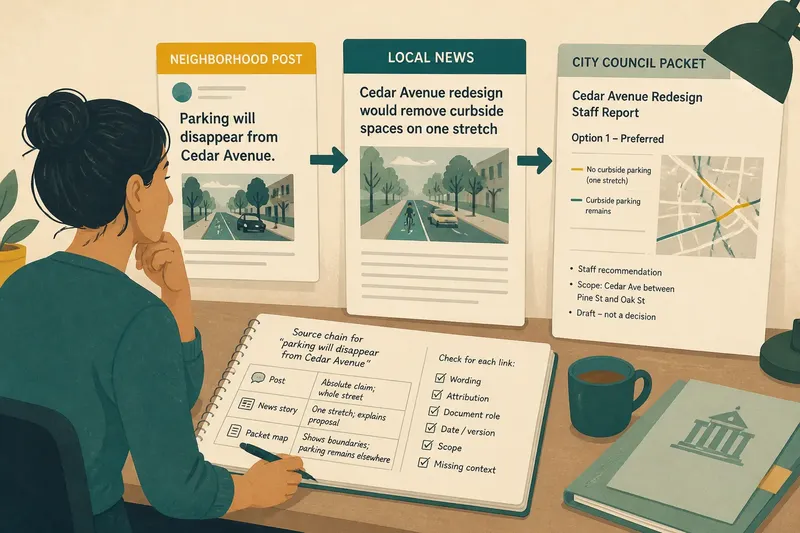
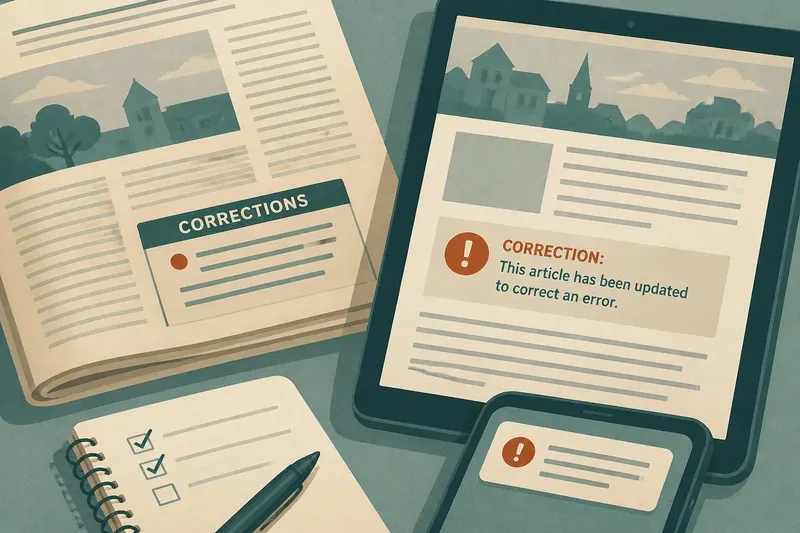
A Claim Is Not the Same as Its Supporting Detail
Claim versus supporting detail: learn to spot when a vivid public assertion outruns its basis and describe precisely what the available information leaves unresolved.
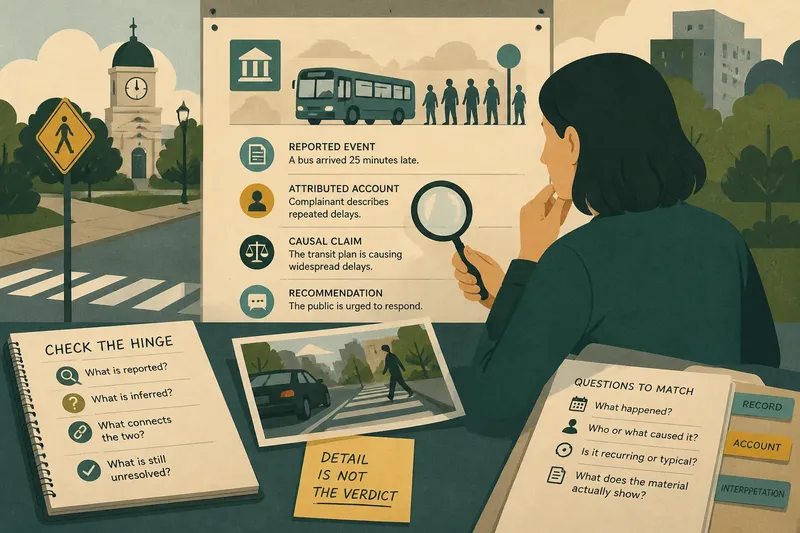
A public notice can turn a small record into a sweeping verdict: a late bus becomes evidence that a transit plan is failing. Claim versus supporting detail is a useful distinction here, because it directs attention to the argument’s hidden hinge: what lets this particular detail carry that conclusion?
Separate the sentence from the inference it invites
Public information often combines several kinds of statements. A notice may report an event, attribute an allegation to someone, interpret a document, and urge a response—all in a few lines. Those parts deserve separate treatment. “A complaint was filed” reports an event; “the complaint describes repeated delays” attributes an account; “the policy caused widespread delays” makes a broader causal assertion.
Instead of treating the wording as one package, ask what role each sentence plays. Is it a record of something that happened, a source’s interpretation, an inference about cause, or a recommendation? This is especially useful when a headline, social post, or public statement compresses those roles and makes interpretation sound like direct observation.
Attribution helps identify who is speaking, but it does not settle whether the attributed account is accurate. A document can establish that a complaint was received without establishing every allegation in it. Likewise, an agency statement establishes the agency’s position, not necessarily the underlying condition it describes.
Trace the argument’s hidden hinge
A detail can be accurate and still leave the central inference unsupported. The missing piece is often a premise about representativeness, cause, or meaning: that the event is typical, that a particular factor produced it, or that the chosen record captures the whole situation.
Take a notice that says a public office is inaccessible because one visitor found its entrance locked. The observation may be precise. To reach the broader conclusion, however, a reader would need to know whether the entrance was locked because of a rule, whether that condition recurs, and whether it prevents access in the way the notice means. The gap is not a reason to dismiss the account; it marks the reasoning still to be supplied.
Words can hide that hinge. “Records” may describe what a document contains, while “shows” suggests a supported interpretation and “proves” makes a stronger claim. “After” places events in sequence; “because” assigns a cause. When a sentence shifts from one commitment to another, look for the missing premise rather than letting forceful wording supply it.
Ask whether the material answers the question the claim raises
A useful check is to match the claim’s central question to the kind of information offered. A claim about what happened calls for an account or record of the event. A claim about who caused it calls for information connecting an actor or policy to the outcome. A claim about a recurring condition needs material that bears on recurrence, not merely a memorable instance.
That does not mean every public statement needs exhaustive documentation. The point is to notice when a source is being asked to do work it cannot do. A list of missed appointments may establish that entries appear in a record; it may not explain the reasons, show how the list was assembled, or establish a broader pattern. The record’s value depends on the question, not its official appearance alone.
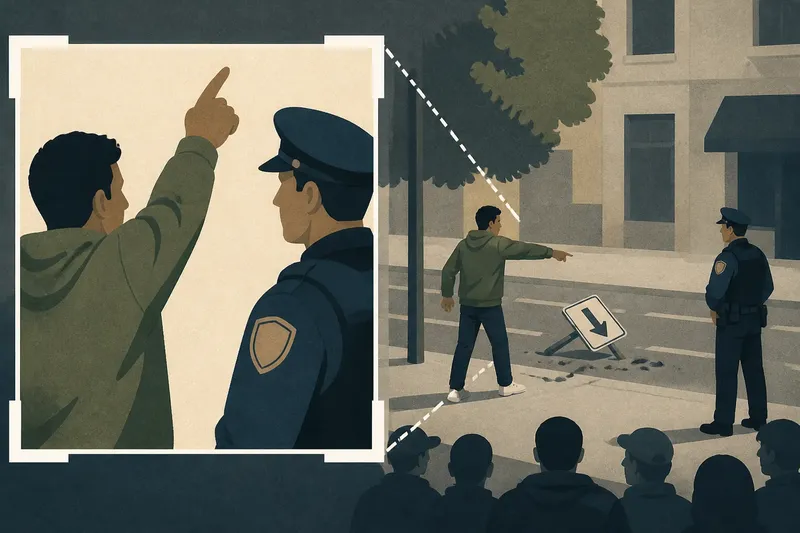
Check the wording around images and documents, too. A photograph may show a scene without identifying when it was taken or what led to it. A chart may present a comparison without explaining which cases were included. Before accepting a caption or interpretation, distinguish what the material depicts from what the accompanying text says it means.
Work through the wording before deciding what it supports
Imagine a neighborhood post says a new crossing is unsafe, citing one driver who stopped suddenly near a person crossing. Start with the actual inputs: the post’s broad safety claim and its account of one sudden stop. Then separate the reported event from the proposed interpretation. The account describes a stop; it does not, by itself, establish the cause, how often similar events occur, or whether the crossing is unsafe overall.
Next, identify what would change the judgment. A contemporaneous account locating the stop at the crossing could clarify where it happened. A description of visibility or traffic conditions could inform possible causes. Other accounts might bear on recurrence, though their presence would not automatically settle the question. The resulting judgment should remain narrow: the post describes a potentially concerning incident, while the general safety claim and its cause remain unresolved. The tradeoff is clear—retain the signal that merits attention without presenting it as a settled verdict.
Why does a public claim outrun its basis?
Does an official document settle what happened?
It can establish what the document records, but interpretation may require context about how the record was made and what it covers. State the documented fact separately from any conclusion that reaches beyond it.
Can a single account be useful?
Yes. It can identify an incident or raise a focused question, even when it cannot establish a general condition. Its usefulness depends on what the claim asks it to support.
What does a photograph establish?
A photograph can show visible details in a scene, but the image alone may not establish its date, location, cause, or what happened outside the frame. Treat captions and interpretations as additional claims to assess.
How can an unresolved claim be described fairly?
Name the information and its limit in the same sentence: “The post describes one sudden stop, but does not establish a recurring safety problem.” That wording recognizes the account without overstating its reach.
Use a short check to choose your wording
Before repeating a public claim, inspect the sentence, its source, and the connection between them. Each check should lead to a decision, not just another open-ended question:
- Observation: The sentence reports an event. If the source directly documents that event, then describe it as a reported or recorded occurrence; otherwise attribute it to the person making the account.
- Observation: The claim names a cause. If the material connects that cause to the outcome, then describe the connection with the strength the material supports; otherwise call the cause an allegation or unresolved interpretation.
- Observation: The claim describes a recurring pattern. If the material addresses recurrence, then state the pattern with appropriate qualification; otherwise limit the wording to the specific incident.
- Observation: The source is an official record. If its contents directly answer the claim, then cite what it records; otherwise separate the record from conclusions about its meaning or completeness.
- Observation: The assertion is attributed to a named source. If the source is identifiable and the wording accurately reflects its statement, then report the attribution; otherwise avoid presenting the assertion as independently established.
- Observation: The claim relies on an image. If its date, location, and relevance are supported, then describe what it depicts; otherwise leave those details open and do not adopt the caption as fact.
It is not worth chasing every remote possibility when a modest claim is directly supported. Spend the effort where the wording changes gears—from an account to a cause, from one event to a recurring condition, or from a record to a verdict.
Claim versus supporting detail is not a contest in which one side must be declared true and the other false. It is a way to choose wording that fits what is actually available. For the bus notice, that might mean saying, “The notice reports a late bus; it does not establish whether the transit plan is failing.” The distinction leaves room for further information while keeping today’s account from carrying more than it can bear.