Original Documents and Secondhand Summaries Answer Different Questions
Compare an original document with a secondhand summary to trace who said what, spot changes in context, and decide which source can answer your question.
An original document and a secondhand summary can tell different stories about the same public decision. If a council agenda labels a Cedar Avenue redesign “curb management,” while a news report describes parking changes, the useful question is how each source was made and what it can establish—not which one deserves automatic trust.
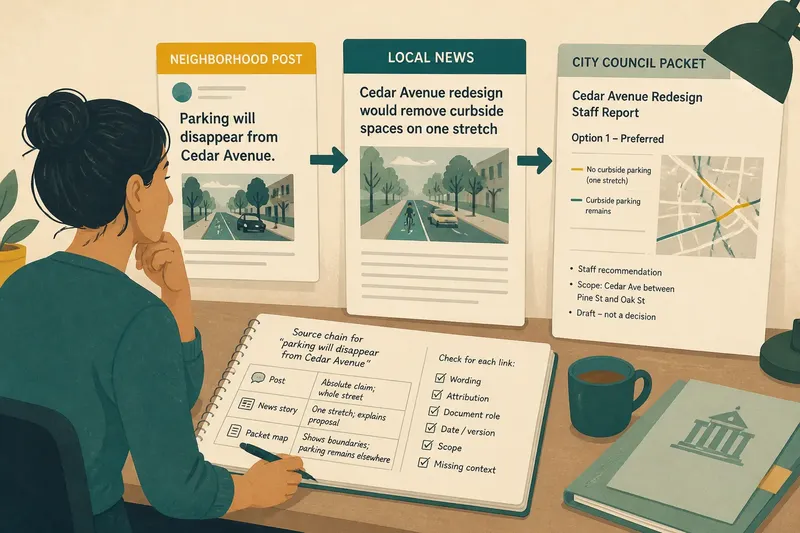
Imagine Maya sees a neighborhood post saying a street plan will eliminate parking on Cedar Avenue. The post links to a local news story; the story points to a council packet. Maya wants to check the sources’ relationship before sharing the claim. Her task is not to declare one source the winner, but to trace which statements came from the record, which are the reporter’s explanation, and which are the post’s interpretation.
Secondhand summaries reveal selection and context
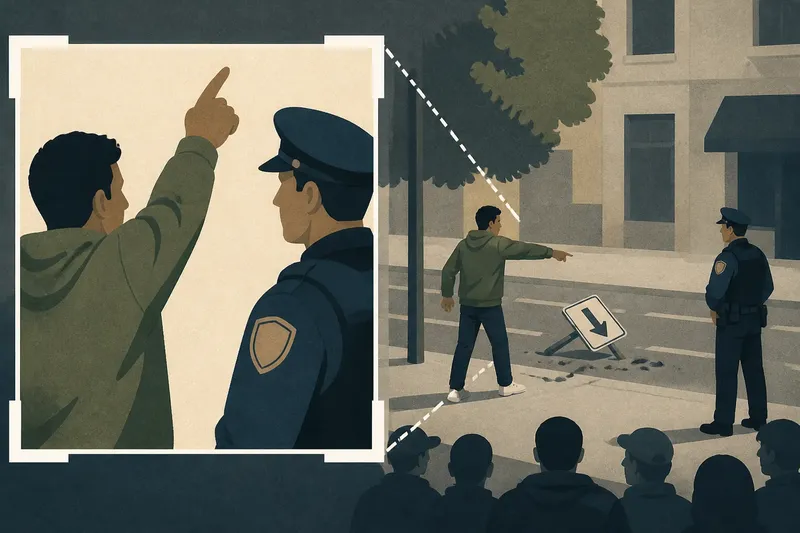
A news report is a source in its own right, but it is secondhand for details drawn from a council packet or meeting. A reporter chooses which documents, voices, and events to include, then organizes them for readers. That work can make a complicated proposal easier to understand: the article may identify the responsible committee, explain whether a vote has occurred, and point readers toward a relevant map.
Selection is also a boundary. A story focused on a bike lane may give less attention to loading access, accessible parking, or changes at intersections. This does not by itself make the report misleading. It gives Maya a reason to check what the story says it covers, how it attributes claims, and whether its headline leaves out a qualification present in the article.
A summary can also add context that an official file does not provide in an accessible form. It may explain how the proposal reached the agenda or distinguish a staff recommendation from a council decision. Maya should keep track of whether those details come from a quoted record, an interview, the reporter’s description, or an inference.
Original records show provenance and document roles
A council packet is an original record in the limited sense that it is issued by the body considering the proposal. Its parts may include a staff report, consultant drawings, public comments, and a draft resolution. These components have different authors and purposes; calling the whole packet “the official view” can hide those distinctions.
Provenance means knowing where an item came from and how it reached the form being read. Maya can check the issuing office, document date, version label, and the author or department named in a section. She can also distinguish an adopted resolution from a draft, a staff recommendation from a council vote, and a public comment from an agency finding.
Official records can preserve exact wording and show what was formally submitted, but they do not independently settle every factual or interpretive question. A map may present a preferred option, while a staff report may address only the scope assigned to its authors. The record’s authority depends on the question: it may establish what a proposal says without showing what will happen after deliberation.
Trace a statement through its source chain
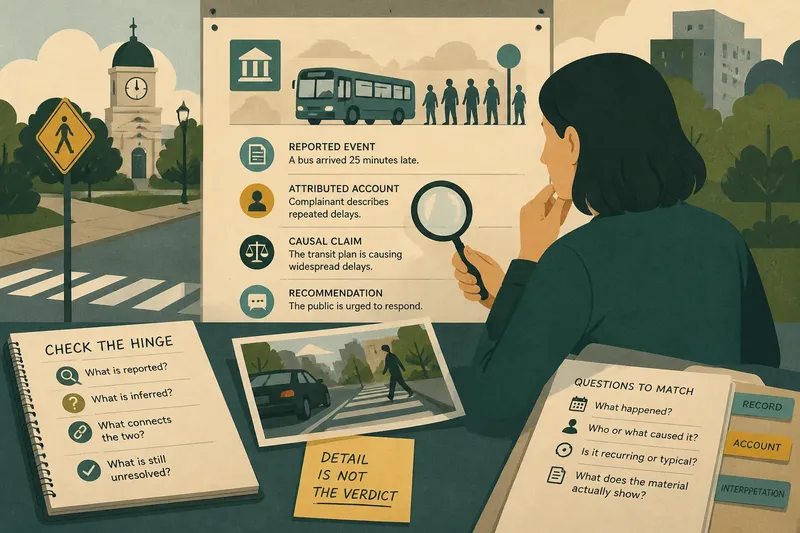
Instead of comparing whole documents in the abstract, Maya follows one statement at a time. She notes the wording in the neighborhood post, finds the corresponding passage in the news story, and then checks the cited section of the council packet. For each link, she asks whether the wording is a quotation, a paraphrase, an inference, or a claim added by the person sharing it.
Say the post says “parking will disappear from Cedar Avenue.” The story says the proposal would remove curbside spaces on one stretch, and the packet’s map marks that stretch while showing curb parking elsewhere. Maya can describe the chain: the post broadens the location; the story narrows it; the map supplies the boundaries. She does not need to decide whether the redesign is wise to report that difference accurately.
For a practical comparison, she can record a few details in a note:
- Wording: Copy the relevant sentence from each source; if the post turns a qualified statement into an absolute one, quote the narrower wording when sharing.
- Attribution: Check whether the story names the packet or another source; if the basis is unclear, look for a citation or choose a report that identifies it.
- Document role: Look for labels such as “draft,” “staff recommendation,” or “adopted”; if the item is not final, describe it as a proposal rather than a decision.
- Date and version: Compare the story date with the packet date; if a later version exists, check whether it changes the detail in question before treating the accounts as contradictory.
- Scope: Find the map legend, location, and limits described in the text; if the record covers only one segment, name that segment instead of implying it covers the whole street.
- Missing context: Check whether the story mentions the decision stage and relevant alternatives; if not, consult the agenda or minutes and add only the procedural detail those records establish.
It is not worth opening every appendix simply to appear thorough. If the question concerns a street segment, a relevant map and its explanation may be enough; an unrelated maintenance attachment adds little. The efficient move is to follow citations and inspect the section that could change the answer.
When do the sources point in different directions?
Which source should answer a question about exact wording?
For the wording of a proposal, check the relevant version issued by the responsible office. A news story can explain that wording, but a paraphrase should not be treated as an exact quotation.
Can a news summary stand in for the record?
It may be sufficient for orientation if it identifies its sources and clearly describes its scope. For a boundary, status, or exact phrase that could alter the account, inspect the cited record directly.
What if the story and packet have different dates?
Compare the versions before calling the difference an error. If a later packet changed the proposal, describe which version each source reflects and check whether the story has been updated.
What if the record uses unfamiliar language?
Use the summary to locate the passage, then check a glossary, another explanation, or the issuing office’s description of the term. If the record does not resolve the point, say what remains unclear rather than assigning it a meaning the source does not support.
Keep the source chain visible when sharing
Maya’s reply can say that the current packet proposes removing curb parking on a particular stretch of Cedar Avenue, while the news story explains that the plan remains under review. She can link both sources and distinguish the packet’s wording from the reporter’s account. That gives neighbors a way to see how the claim traveled without turning a sourcing question into a verdict on the project.
For readers comparing an original document with a secondhand summary, the useful habit is to preserve provenance: identify who created each item, what kind of document it is, and which version it describes. Then follow the source chain for the statement that matters. This makes it easier to notice when a paraphrase, headline, or repost has changed the wording or dropped context.
Maya’s post need not reproduce the packet or resolve the council’s eventual choice. It should make clear which source says what and where their accounts differ. That small distinction helps readers ask the next question of the right source.